
· 3 min read
Cork wallpaper: the new sustainable luxury of 2026
Cork is winning over fine walls: a Mediterranean, renewable and sensory material that redefines the idea of sustainable luxury.
Published on 11 September 2026 · WALLZAD editorial team
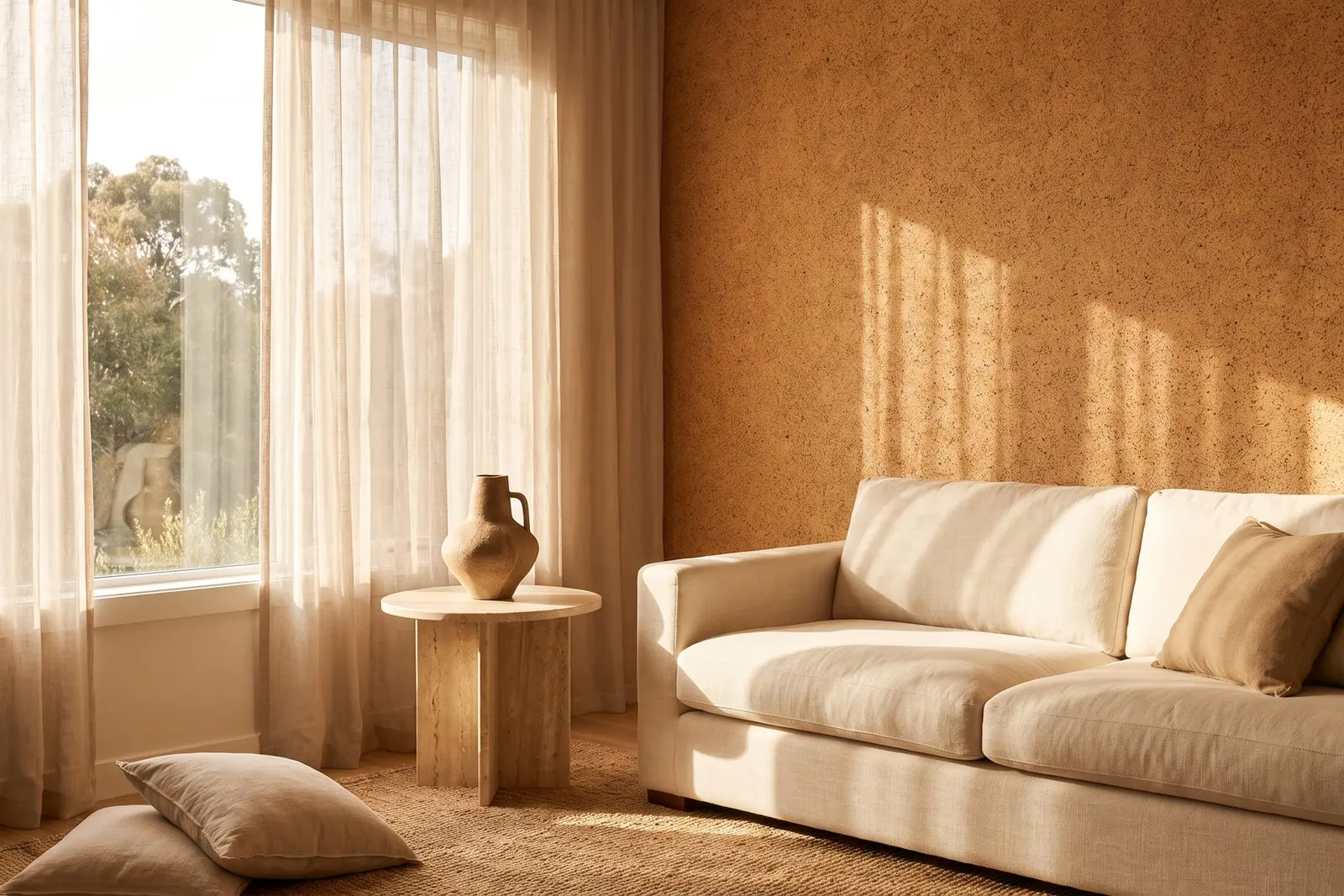
In the world of high-end furnishing, 2026 brings to the fore a material as old as Mediterranean civilisation and at the same time surprisingly contemporary: cork wallpaper. This is not a passing fancy, but the natural development of a sensibility that in recent years has shifted attention from decorative pattern to the material of the wall itself, favouring surfaces that can be touched as well as looked at.
Cork wallpaper and the memory of the Mediterranean oak
Cork belongs to a precise geography: that of the cork oak woods dotting the Mediterranean basin, from Sardinia to Portugal, where the bark of the cork oak is stripped at regular intervals without the tree ever being felled. It is a harvest repeated for the whole life of the plant, often centuries old, and one that made this material a natural symbol of renewability well before the word sustainability entered the vocabulary of design. For centuries confined to utilitarian uses, from the bottle stopper to the office noticeboard, cork is today valued anew for its sensory and visual richness.
The change of pace emerged clearly during the last edition of Milan Design Week, when cork was among the most discussed materials of the week, present in sculptural seating, wall coverings and accessories with a strongly tactile character. From humble material to precious one: a path that contemporary design takes willingly, but which in the case of cork appears particularly coherent, because its beauty imitates nothing, it simply gives back itself.
Warmth, silence and texture: the qualities luxury looks for today
What sets cork apart from other natural wall coverings is a combination of qualities hard to find elsewhere. The surface, warm and amber, shows subtle shifts of shade that catch the light differently through the day, offering depth with no need for decoration. To this aesthetic quality are added practical properties that the luxury hospitality sector appreciates particularly: a natural capacity for acoustic absorption, a degree of thermal insulation and antimicrobial characteristics intrinsic to the material itself.
It is no accident that cork is today set alongside, in the most authoritative trend reports, materials such as jute, linen and embroidered silk: all part of the same family, that of coverings which give the wall back an artisanal, tactile dimension, in response to a daily life increasingly mediated by digital, polished surfaces.
A material for contemplative hospitality
In high-end hospitality, where the guest’s sensory experience is an integral part of the architectural narrative, cork wallpaper finds natural ground. Its sound-absorbing properties make it suited to spaces that seek silence as a form of luxury, while its renewable origin answers a demand for environmental authenticity that the most demanding clients no longer consider optional, but part of the overall quality of the project.
It remains a material that seeks not immediate astonishment but faithfulness over time: its surface, free of invasive treatments, invites a slow relationship with the space, closer to the one established with wood or natural stone than with a decorative covering in the classic sense of the term. Even dyed in deeper shades, from chocolate to charcoal, cork does not lose its organic grain, the mark that sets it apart from any imitation. In this, perhaps, lies its true elegance: a material that does not impose a language but simply gives back its own nature, in silent dialogue with whoever inhabits the space.
Frequently asked questions
What exactly is cork wallpaper?
It is a wall covering made from thin layers of cork oak bark applied to a backing, which keeps the natural texture, the colour variation and the porosity characteristic of the raw material.
Why is cork considered a sustainable material for walls?
Because the bark is stripped periodically from the cork oak without felling the tree, which goes on living and regenerating its own bark for decades, making the harvest a naturally renewable process.
Does cork wallpaper really have acoustic properties?
Yes: the cellular structure of cork, full of small air cavities, gives it a natural ability to absorb sound, reducing reverberation in a room and contributing to a greater sense of calm.
In which luxury interiors does cork sit best?
It works well in living rooms, studies and the areas of contemplative hospitality where visual warmth and acoustic quiet are sought, while its thermal properties also make it of interest in transitional spaces and panelling.
Wallpapers mentioned in this article


Keep reading
- Moiré wallpaper: the rippling sheen of 2026 · 9 September 2026
- Hand-painted wallpaper: the return of craftsmanship · 6 September 2026
- Natural wood wallpaper: the return of veneer · 4 September 2026